Amoxicillin
The solution to antibiotic resistance?
Sophia Powell
Bristol University
Molecule of the Month July 2026
Also available: HTML version.
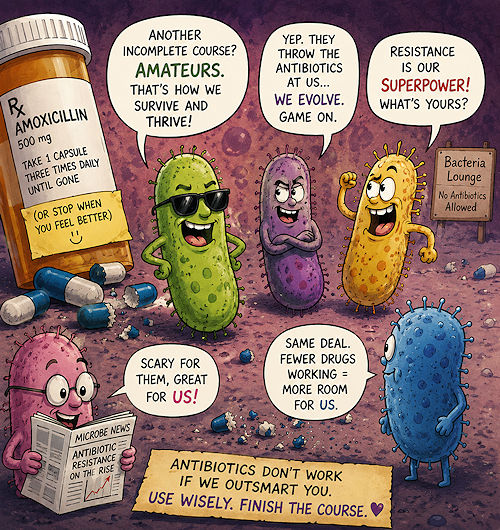
[Image: Paul May, created using ChatGPT]
AmoxicillinThe solution to antibiotic resistance?
Sophia Powell
Molecule of the Month July 2026
|
[Image: Paul May, created using ChatGPT] |
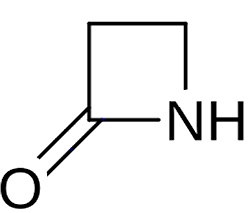
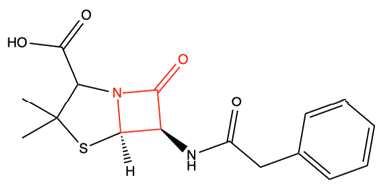
Amoxicillin? That sounds a lot like penicillin…Correct, amoxicillin is an antibiotic synthesised from penicillin. It’s actually known as an aminopenicillin, which, as the name suggests, is penicillin (see MOTM for May 2024) with an amino group added. Penicillin was discovered by Sir Alexander Fleming in 1928, by accident, as he noticed a transparent ring forming around contaminated Staphylococcus on a petri dish, which was forgotten about over the summer. This zone of inhibition indicated that the fungus present, Penicillium notatum, produced a bactericidal compound that killed the Staphylococcus bacteria, which he named penicillin. His findings were initially disregarded until World War II, when penicillin saved millions of lives and initiated the era of antibiotic usage. Before penicillin, the leading cause of death throughout history was infectious disease, and penicillin was the first non-toxic medicine to combat this that could destroy bacteria outside the body whilst not being destroyed itself. Like penicillin, amoxicillin is a part of a class of antibiotics known as beta-lactams (β-lactams). A lactam is a cyclic amide, and they are named α-, β-, γ- or δ-lactams according to whether the ring is 3-, 4-, 5- or 6-membered, respectively. Due to the square shape of a β-lactam ring, the intermolecular angles at each carbon are at 90°, compared with the usual 109.5° or 120° for a five- or six-membered ring. This causes tension within the ring, and the carbonyl group provides a site for nucleophilic attack to hydrolyse the ring and relieve this tension, making β-lactams very reactive.
|
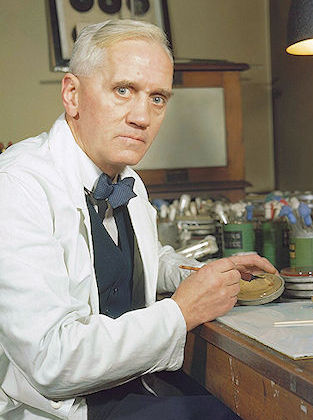 Sir Alexander Fleming in his laboratory at St Mary's, Paddington, London, in 1943 [Image: Official photographer, Public domain, via Wikimedia Commons] |
 |
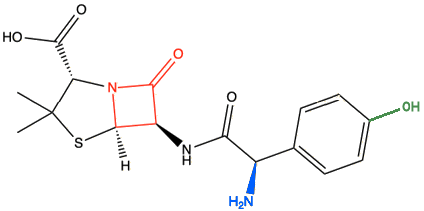 |
| Penicillin The β-lactam is highlighted in red. |
Amoxicillin The β-lactam is red, the added amine group in blue, and the extra OH group in green. |
The structure of a β-lactam is similar to that of D-alanine-D-alanine, a dipeptide involved in crosslinking chains of carbohydrate sugar molecules (glycans) to form peptidoglycan, the crucial polymer in bacterial cell walls. Due to the similarities in structure, in 1974, scientists Blumberg and Strominger concluded that β-lactam antibiotics work by inhibiting bacterial cell-wall biosynthesis, killing the bacteria.
There are two types of bacteria: Gram-positive and Gram-negative, which are classified based on their cell-wall structures and present different colours after Gram staining. The cell-wall structure determines many bacterial properties, particularly their response to external factors such as temperature and pH. Gram-positive bacteria have a thick cell wall made from a thick layer of a sugar-based polymer called peptidoglycan (20 to 80 nm), whilst Gram-negative bacteria have a thin cell wall with a thin layer of peptidoglycan (< 10 nm), but with an additional lipid membrane surrounding. Due to these differences, the way in which each type of bacteria is treated differs. The thick peptidoglycan layer of Gram-positive bacteria makes it easy for β-lactam antibiotics to inhibit the polymerisation reactions that create the cell wall, and the cell dies. Therefore, Gram-positive bacteria are often easier to treat with penicillin than Gram-negative bacteria.
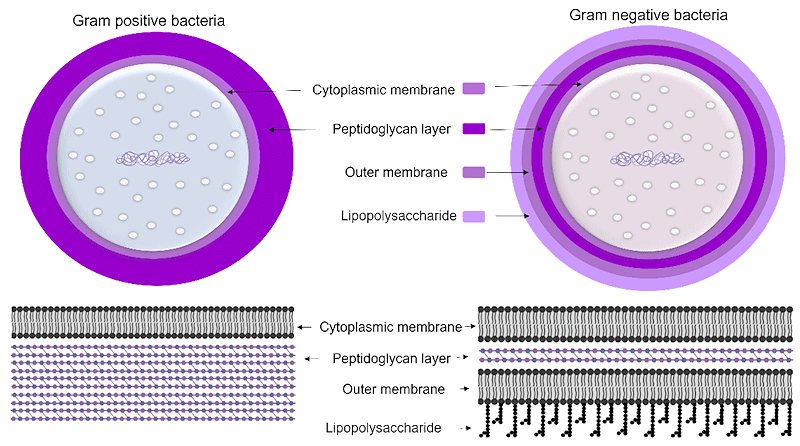
The different cell walls in Garm-positive and Gram-negative bacteria.
[Image: Malihe Mehdizadeh Allaf and Hassan Peerhossaini, CC BY-SA 4.0 via Wikimedia Commons]
However, amoxicillin is often more widely used as it has a broader spectrum than penicillin and is effective against many Gram-negative bacteria as well as Gram-positive ones. It treats many infections in the throat, ears, nose, skin, lower respiratory tract, etc. Amoxicillin is taken orally, in various forms, and has a more palatable taste than penicillin, so it is usually preferred by children. It is a safe drug, generally accepted in the body with little side effects, and, via potentially adjusting the dosages, can be used by pregnant or breastfeeding women, those with renal and/or hepatic impairments and older patients.
 And it's not as affected by antibiotic resistance?
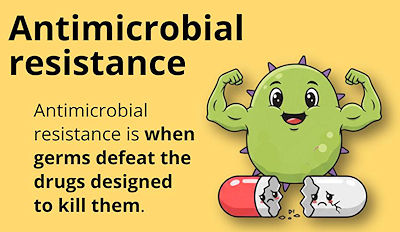
Yes. Antibiotic resistance refers to a microorganism’s ability to survive antibiotic exposure, and the constantly growing number of bacteria that are becoming resistant. When bacteria are resistant to multiple different antibiotics, it can result in infections that are extremely difficult, if not impossible, to treat with conventional antibiotics. Being the cause of hundreds of thousands of deaths every year, in 2014, the World Health Organisation officially called it a “major global health threat”.
Well, each time bacteria are exposed to different antibiotics with different properties, evolution constantly adapts to find a way to overcome them. Excess antibacterial agents being present places a strong selection pressure on the bacterial population. This pressure either kills the bacteria off or forces bacterial pathogens to mutate to become immune, surviving the selection. These mutations may be inherited or acquired via gene transfer from other microorganisms, but ultimately, they spread quickly to form a new, resistant population of bacteria. The generation time of bacteria (the time it takes for the population to double via binary fission) is very short, meaning evolution occurs very quickly. Therefore, the miracle antibiotics curing World War II infections are no longer effective, prompting the search for a fix. Overprescribing is a significant cause of antibiotic resistance, as each time antibiotics are used, bacteria are provided with an opportunity for resistant strains to survive. Another common cause is patients not completing their course of antibiotics, stopping when they feel better, or picking up leftovers from an old course they did not finish to self-treat an illness. Neither scenario fully kills the bacteria causing the infection, allowing surviving bacteria to reproduce. The battle against antibiotic resistance has been occurring not only in a clinical setting, but also in agriculture, where laws now limit antibiotic usage as livestock feed additives. Previously, farmers used antibiotics liberally to prevent disease and promote growth. This widespread use encouraged the development of antibiotic-resistant bacteria, which could be easily transmitted to humans via the food chain, environment, or direct contact.
So, how is amoxicillin a solution to this?As previously mentioned, the β-lactam rings are very reactive, and so they can be opened in acidic or basic solutions, causing the antibiotic to become inactive, as shown in the cartoon (right). Similarly, some bacteria produce an enzyme, β-lactamase, which degrades the β-lactam ring, consequently degrading the antibiotic. Therefore, penicillin antibiotics must be developed to resist these forms of degradation by modifying the side chain. Firstly, amoxicillin has an additional hydroxyl group (shown in green in the structural diagram above) to penicillin, making it more soluble and therefore more bactericidal due to its increased absorption in the gut and consequent distribution into organs. Generally, β-lactams can be stabilised by adding a bulky or electron-withdrawing group to the side-chain. In amoxicillin’s case, it is the latter. The side-chain contains an electron-withdrawing amine group, making it more stable and so less likely to degrade in stomach acid, prolonging its bioactivity. |
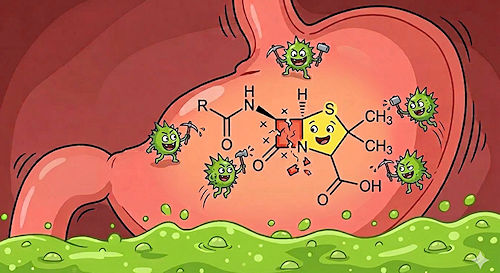 Stomach acid degrading the β-lactam ring of penicillin [Image: Sophia Powell via ChatGPT] |
Additionally, this amine group is what makes amoxicillin active against Gram-negative bacteria, allowing the antibiotic to penetrate through the otherwise almost impermeable outer membrane of the bacterial cell. This works through porins in the membrane, which are essentially protein channels that allow only certain molecules through, hence why penicillin is not effective against Gram-negative bacteria. Ultimately, improving the limitations of penicillin through increased absorption, stability and efficacy, amoxicillin battles antibiotic resistance, as killing off all the bacteria leaves no opportunity for resistant genes to be passed on.
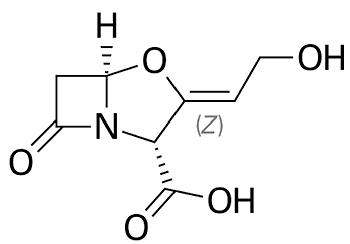
Not quite. Amoxicillin can still be susceptible to degradation by β-lactamase-producing bacteria, so it is sometimes prescribed alongside a β-lactamase inhibitor. Due to the increasing concern of antibiotic resistance, in 1967, a mass screening began to search for microorganisms that could potentially produce compounds that inhibit β-lactamase enzymes. Five years later, clavulanic acid was identified, which is a weakly antibacterial β-lactamase inhibitor produced by Streptococcus clavuligerus. It prevents the inactivation of β-lactam antibiotics by irreversibly binding to β-lactamase, preventing it from working.
 |
 |
|
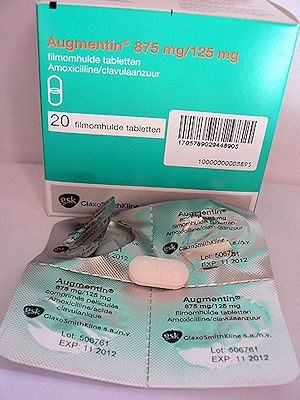
| Clavulanic acid | Tablets of Augmentin, containing amoxicillin and clavulanic acid [Bree, Public domain via Wikimedia Commons] |
Due to amoxicillin’s efficient oral absorption and diverse activity, it was chosen as an antibiotic to co-administer with clavulanic acid, resulting in the Augmentin tablet, released in the United Kingdom in 1981. The amoxicillin/clavulanate combination allowed amoxicillin’s antibacterial activity to be broadened, as it retained its original activity whilst restoring effectiveness against β-lactamase-producing bacteria such as Staphylococci, Escherichia coli, and Haemophilus influenzae. 25 years after its launch, Augmentin was reassessed and found to retain the same rationale, leading to the development of higher-dose and modified formulations to continue to combat antibiotic resistance.
So, problem solved...?Unfortunately, this is not quite the simple solution to antibiotic resistance that it seems to be. The absorption of clavulanic acid in the body varies much more than that of amoxicillin, even in healthy patients. Also, when clavulanic acid is taken orally, there is a higher possibility of gastrointestinal side effects than when amoxicillin is taken alone, especially diarrhoea. Taking these two factors into account, means the amoxicillin dose must be limited when co-administered with clavulanic acid. The ratio of amoxicillin to clavulanic acid is also important to consider. For optimal treatment of Gram-negative organisms, higher doses of both amoxicillin and clavulanic acid are required. Therefore, a smaller ratio (around 4:1) with doses given more frequently (four times rather than two) is beneficial. |
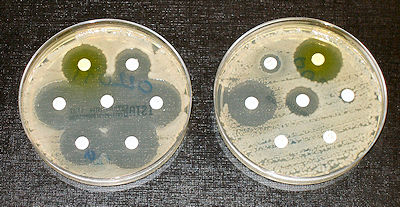 Antibiotic-resistant bacteria. The bacteria (E. coli) in the culture on the left are sensitive to the 7 different antibiotics contained in the white paper discs. But the bacteria on the right are resistant to most of these antibiotics. [Dr Graham Beards at en.wikipedia, CC BY-SA 4.0 via Wikimedia Commons] |
Gram-positive organisms, however, bind clavulanic acid more readily and require lower concentrations of amoxicillin; therefore, a larger ratio (like 7:1) with fewer doses is sufficient. Whilst extreme ratios have been used (like 17:1), there is little data surrounding this, and so caution should be taken. Ultimately, amoxicillin’s versatility and ability to co-administer with clavulanic acid help prevent antibiotic resistance briefly. However, it is not a full solution, and antibiotic resistance remains a global concern.
 Back to Molecule of the Month page. [DOI:10.6084/m9.figshare.32649192]