
Kratom
(Mitragynine)
One of the new ‘gas-station drugs’
causing concern in the US.
Simon Cotton
University of Birmingham
Molecule of the Month August 2026
Also available: JSMol version.
|
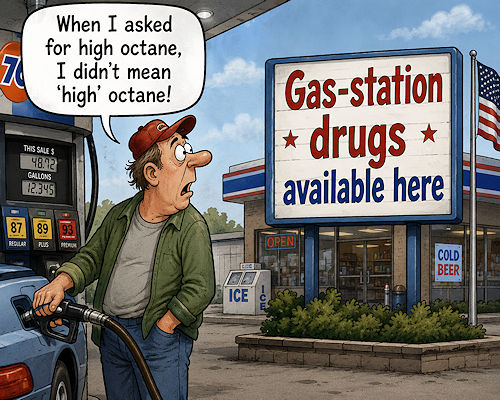
[Image: Paul May, created using ChatGPT] |
Kratom? Sounds like a mnemonic to help you remember that krypton is a monatomic noble gas... Kr-atom
Nice try, but that isn't the reason.
So what is it, then?
Kratom is one name given to the leaves of a plant, Mitragyna speciosa Korth (M. speciosa), which grows in Southeast Asia. Kratom is one name that they call it in Thailand, as well as kakuam, kraton, ithang or thom; in Malaysia it is known as Biak-Biak or Ketum.
|
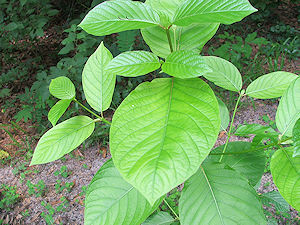
Mitragyna speciosa (kratom)
[Image: Uomo vitruviano, CC BY-SA 3.0 via Wikimedia Commons] |
And why are we reading about it?
Well, for many years people in that part of the world have consumed the leaves – either by chewing or smoking, as well as drinking tea made from them. It’s a bit reminiscent of khat, the evergreen shrub Catha edulis found in East Africa - its leaves are chewed by many people in countries including the Yemen, where the stimulant is the cathinone molecule (MOTM September 2018), with the purpose of reducing fatigue. The parallel seems good, as people have said that chewing kratom was very much a way of life in Thailand, but now it is criminalised.
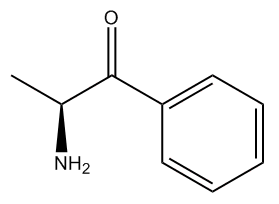
Cathinone
 Why do people chew kratom?
People, particularly agricultural workers in very hot climates, have taken kratom to fight fatigue too, and help them work harder. In small amounts, there is perceived to be a stimulant effect, but at high levels kratom has opioid effects. Kratom is also believed to give pain relief. There have been claims that some strains are more effective than others, but a 2023 study suggests that there are no differences in alkaloid content between different strains.
Which molecule causes the opioid effects?
A very different molecule to the one in khat (cathinone). The kratom leaves contain some fifty different alkaloids, and the effective molecule has been identified for many years as mitragynine, which of course takes its name from the plant where mitragynine is found.
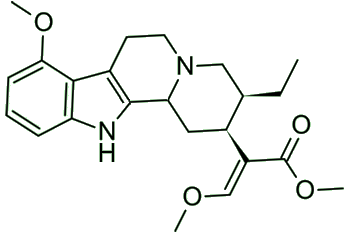 |
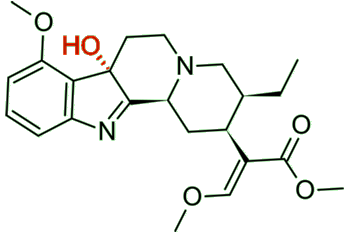 |
| Mitragynine |
7-Hydroxymitragynine (7-OH) |
Do we know how it works?
Tests have shown that it binds to the human opioid receptors in the human brain (specifically the μ, κ- and δ-opioid receptors) which are known to be targetted by other opioids, such as morphine or heroin, causing similar effects. One benefit is that mitragynine does not have the lethal respiratory depressing effects associated with some other opioids (e.g. morphine). But kratom’s effects are not all down to mitragynine.
What do you mean?
Recent research, published in 2019, shows that - in both human and mouse liver - mitragynine is hydroxylated into 7-hydroxymitragynine, often called 7-OH, which is a substantially more potent μ-opioid receptor agonist.
Why does the liver put -OH groups into mitragynine?
-OH groups are hydrophilic (just think of H2O) so it makes the molecule more water soluble and easier to excrete from the system.
Does it have any legitimate medical uses?
In northern Malaysia ketum (as Mitragyna speciose is locally known) is used as a treatment for opioid withdrawal. The use of kratom has spread from Asia to places including the U.S.A., as a painkiller and also as a tool to treat opioid dependence, sometimes in opioid withdrawal, though controlled clinical studies are lacking. But now it's moved over into the recreational drug market...
Why is that a problem?
Both mitragynine and 7-OH are opioids, and therefore as well as acting as narcotic painkillers they are also addictive. As a result, kratom use is now a criminal offence in Thailand, and is banned in Malaysia. But in some places in Europe and especially in the U.S.A., it is seen as a 'legal high', with people consuming extracts rather than the leaves themselves, and buying them legally in stores and gas stations.
I’ve heard of these ‘gas-station drugs’…
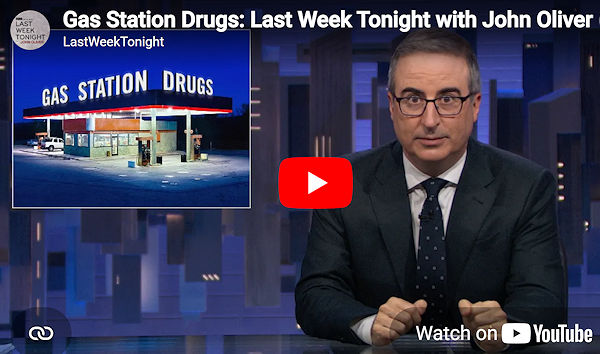
They can also be called 'gas-station heroin'! They got these names because they are openly and legally sold in many corner stores and gas stations in the USA. Indeed, the comedian John Oliver did an entire TV show in May 2026 exposing these gas-station drugs in his programme 'Last Week Tonight', saying:
"It is hard to believe that something so immediately dangerous could be sold at the gas station next to the lottery tickets. It would be like finding out that PetSmart sells hand grenades next to the hamsters."
|
 |
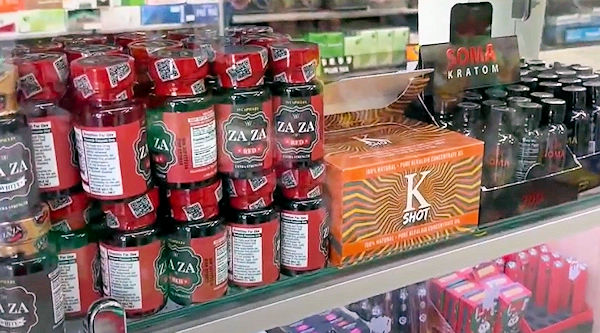
A selection of 'gas-station drugs' available legally in the US, including Za Za (whose active ingredient is tianeptine, an anti-depressant drug and heroin substitute, and K-Shot and Soma, both of which contain kratom. |
How is this possible?
Labelling these drugs as 'Dietary supplements' or 'For research purposes only' allows the people who make them to get around the laws against dangerous drugs. According to the US Dietary Supplement Health and Education Act 1994, there currently exists no central process whereby products calling themselves ‘supplements’ are tested or approved by the FDA before they hit the shelves. This means that manufacturers can produce new drugs, or simply repackage existing ones, and distribute them to gas stations and other small shops faster than they can be tested and banned.
|
This sounds worrying?
It should be! Despite estimates suggesting that the risk of overdose death for kratom by itself is at least a thousand times lower than for other opioids, such as fentanyl (MOTM March 2015), heroin (MOTM March 2023) and prescription opioids like oxycodone (MOTM December 2015), the contributing factor to the problem is the marketing of mitragynine in mixtures with these other drugs. One example is a mixture of mitragynine and o-desmethyltramadol (MOTM Sept 2014) in a popular product called ‘Krypton’. In the U.S.A., a 2024 report found that kratom and 7-OH contributed to, or caused, at least 4,100 deaths over a three-year period from this or similar lethal opioid mixtures.
What about in the UK?
In the UK, as well as in most European countries, kratom is illegal to supply, sell, import, or export. It is banned in the UK under the Psychoactive Substances Act 2016, and under similar laws in other countries. But, as of the time of writing, it remains unrestricted in Germany, Austria, Spain and the Netherlands, and its sales are regulated in Czechia.
Bibliography
- Chapman and Hall Combined Chemical Dictionary code number: CGL82-M (mitragynine).
- Wikipedia: Mitragyna_speciosa; 7-OH;
- The Guardian, "John Oliver on gas station drugs: ‘Dangerous substances that can be made by just about anyone’", May 2026.
- D. E. Zacharias, R. D. Rosenstien and G.A. Jeffery, Acta Crystallogr., 1965, 18, 1039-1043 (crystal structure of hydroiodide salt)
- C. M. Lee, W.F. Trager and A.H. Beckett, Tetrahedron, 1967, 23, 375-385 (absolute. config. of mitragynine)
- A.H. Beckett, D. Dwuma-Badu and R.E. Haddock, Tetrahedron, 1969, 25, 5961-5969 (mass spec)
- N. Nagakura, M. Rüffer and M. H. Zenk, J. Chem. Soc., Perkin Trans. 1, 1979, 2308-2312 (biosynthesis)
- H. Takayama, et al., Tetrahedron Lett., 1995, 36, 9337-9340 (synthesis)
- H. Takayama, Chem. Pharm. Bull., 2004, 52, 916-928 (review)
- J. Ma, W. Yin, H. Zhou, X. Liao and J. M. Cook, J. Org. Chem., 2009, 74, 264-273 (synthesis)
- B. Vicknasingam, S. Narayanan, G. T. Beng and S.M. Mansor, Int. J. Drug Policy, 2010, 21, 283–288 (use of Mitragyna speciosa for opioid withdrawal in the northern states of peninsular Malaysia)
- Z. Hassan, et al., Neurosci. Biobehavioral Rev., 2013, 37, 138–151 (review of physiological and behavioural effects related to use, abuse, and addiction)
- S. Gibbons and W. Arunotayanun, “Natural Product (Fungal and Herbal) Novel Psychoactive Substances”, in: - P.I. Dargan and D.M. Wood, Novel Psychoactive Substances: Classification, Pharmacology and Toxicology, Amsterdam, Academic Press, 2013, pp. 345-362, at pages 352-354.
- T. M. Scott, J. K. Yeakel and B. K. Logan, Drug Test. Analysis, 2014, 6, 959–963 (‘krypton’ containing mitragynine and o-desmethyltramadol, possibly fatal)
- S. Ramanathan, S. Parthasarathy, V. Murugaiyah, E. Magosso, S. C. Tan and S. M. Mansor, Molecules, 2015, 20, 4915-4927 (review, physical properties)
- N.H.M. Yusoff, et al., Addiction Biol., 2016, 21, 98-110 (abuse potential and adverse cognitive effects of mitragynine)
- A. C. Kruegel, M. M. Gassaway, A. Kapoor, A. Varadi, Susruta Majumdar, M. Filizola, J. A. Javitch and D. Sames, J. Am. Chem. Soc., 2016, 138, 6754−6764 (mitragynine and related alkaloids bind to human μ-opioid receptors in the brain, spinal cord, and GI tract)
- M. T. Swogger and Z. Walsh, Drug and Alcohol Dependence, 2018, 183, 134–140 (Kratom use and mental health reviewed)
- A.C. Kruegel, et al., ACS Cent. Sci., 2019, 5, 992-1001 (7‑hydroxymitragynine as an active metabolite of mitragynine mediating its analgesic effects)
- J. E. Henningfield, O. Grundmannc, J. K. Babind, R. V. Fanta, D. W. Wanga and Edward J. Cone, Preventive Medicine, 2019, 128, 105851 (risk of death associated with kratom use compared to opioids)
- S. C. Eastlack, E. M. Cornett and A. D. Kaye, Pain. Ther., 2020, 9, 55–69 (Kratom pharmacology)
- C. Han, J. Schmitt and K. M. Gilliland, ACS Chem. Neurosci., 2020, 11, 3870−3880 (DARK Classics in Chemical Neuroscience: Kratom)
- E. A. Maxwell, T. I. King, S. H. Kamble, K. S. R. Raju, E. C. Berthold, F. León, B. A. Avery, L. R. McMahon, C.R. McCurdy and A. Sharma, Planta Med., 2020, 86, 1278-1285 (7-hydroxymitragynine testing in beagles)
- J. M. Rogers, K. E. Smith, J. C. Strickland and D. H. Epstein, Front. Pharmacol., 2021, 12, 789075 (Kratom use in the USA)
- J. Schimmel, E. Amioka, K. Rockhill, C. M. Haynes, J.C. Black, R.C. Dart and J.L. Iwanicki, Addiction 2021, 116, 176−181 (Kratom use in the USA)
- S. Ramanathan , F. León, N. J. Y. Chear, S.R. Yusof, V. Murugaiyah, L. R. McMahon and C. R. McCurdy, Stud. Nat. Prod. Chem., 2021, 69, 195-225 (mitragynine, review)
- T. Karunakaran, K. Z. Ngew, A. A. D. Zailan, V. Y. M. Jong and M. H. A. Bakar, Front. Pharmacol., 2022, 13, 805986 (mitragynine and Its diastereomers reviewed)
- J. Sakamoto, M. Kitajima and H. Ishikawa, Chem. Pharm. Bull., 2022, 70, 662-668 (asymmetric total synthesis of mitragynine and 7-hydroxymitragynine)
- C. Schotte, Y. Jiang, D. Grzech, T-T. T. Dang, L. C. Laforest, F. Leon, M. Mottinelli, S. S. Nadakuduti, C. R. McCurdy and S. E. O’Connor, J. Am. Chem. Soc., 2023, 145, 4957-4963 (biosynthesis)
- R. Hossain, A. Sultana, M. Nuinoon, K. Noonong, J. Tangpong, K. H. Hossain and M. A. Rahman, Molecules, 2023, 28, 7372 (neuropharmacological effects of Kratom reviewed)
- G. Huisman, M. Menke, O. Grundmann, R. Schreiber and N. Mason, Int. J. Environ. Res. Public Health, 2023, 20, 642 (no differences in alkaloid content between strains of Kratom)
- A. N. Edinoff, et al., Cureus, 2024, 16, e73058 (review of possible clinical uses and dangers of Kratom)
- M. A. Huestis, M. A. Brett, J. Bothmer and R. Atallah, Molecules, 2024, 29, 984 (controlled administration study)
- J. Ganasan, T. Karunakaran, Y. Marimuthu, N. N. Rusmadi, N. S. Firouz, J. Jenis and U. S. U. Kumar, Phytochem. Rev., 2025, 24, 4051–4064 (review on 7-hydroxymitragynine)
Fatalities involving mitragynine
- R. Kronstrand, M. Roman, G. Thelander and A. Eriksson, J. Anal. Toxicol., 2011, 35, 242-247 (unintentional fatal intoxications with mitragynine and o-desmethyltramadol from the herbal blend 'Krypton')
- J. M. Holler, S.P. Vorce, P.C. McDonough-Bender, J. Magluilo Jr., C.J. Solomon and B. Levine, J. Anal. Toxicol., 2011, 35, 54–59 (fatality involving propylhexedrine and mitragynine)
- M. F. Neerman, R.E. Frost and J. Deking, J. Forensic Sci., 2013, 58 (Suppl. 1), S278–S279 (fatality involving kratom)
- R. Karinen, J. T. Fosen, S. Rogde and V. Vindenes, Forensic Sci. Int., 2014, 245 e29–e32 (accidental poisoning with mitragynine)
- I.M. McIntyre, A. Trochta, S. Stolberg and S. C. Campman, J. Anal. Toxicol, 2015, 39, 152–155 (mitragynine related fatality)
- D. C. Mata and H. H. Chang, Acad. Forensic Pathol., 2023, 13, 34-40 (death caused by an accidental overdose of mitragynine)

 Back to Molecule of the Month page. [DOI:10.6084/m9.figshare.32588586]