
Lactic acid
(a.k.a. 2-hydroxypropanoic acid)
Cheesemakers like it, athletes don't
Roderick Edmonds
Eton College, UK
Molecule of the Month June 2026
Also available: HTML version.
[Image: ChatGPT creation]
|
Lactic acid(a.k.a. 2-hydroxypropanoic acid)Cheesemakers like it, athletes don't
Roderick Edmonds
Molecule of the Month June 2026
|
[Image: ChatGPT creation] |
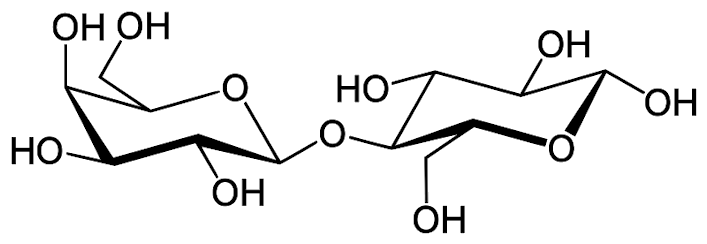
Yes. The main sugar naturally present in milk is lactose, and lactic acid is formed when Lactobacilli bacteria ferment this. That's what happens when milk goes sour, but it's also the first stage in the production of cheese and yogurt.
 |
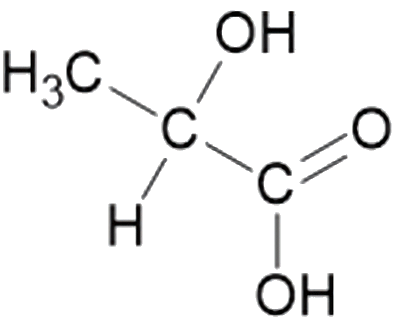 |
| Lactose | Lactic acid |

Plenty of lactic acid here!
[Image: Roderick Edmonds]
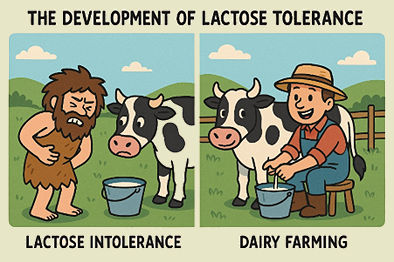
I can't eat yogurt. I'm lactose intolerant!So were all the adult human population, until comparatively recently. Most mammals only consume lactose as infants, from their mother's milk. After weaning, they stop producing lactase, a key enzyme needed for the digestion of lactose. Around 10,000 years ago, humans began to keep cattle, originally as a source of meat and as draft animals. Mutations in the human genome then arose which caused the gene for lactase to be expressed throughout adulthood, allowing the consumption of milk as an extra source of nutrition. The mutations became established mainly in societies with a tradition of dairy farming. At least half the world's population are lactose intolerant today; the condition is particularly prevalent in those of East Asian descent, where historically dairy farming wasn't common. But remember this is a problem with lactose, not lactic acid. |
 [Image: Roderick Edmonds via Microsoft Copilot] |
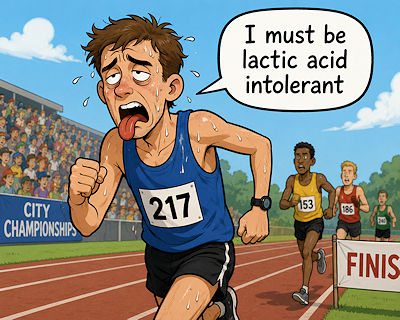
It's fine for athletes who are lactose tolerant to eat yogurt. The problem is the accumulation of lactic acid in muscle tissue through anaerobic respiration.
For the most part, yes, and that's all to the good. Aerobic respiration involves the production of adenosine triphosphate (ATP) via oxidation of glucose. ATP is the molecule which powers all the processes your body needs to function, and you can read more about it in the MOTM article from January 1998. The exact amount of ATP produced is still unclear, but it is around 31 molecules of ATP from the oxidation of one molecule of glucose.
C6H12O6 + 6O2  6CO2 + 6H2O (+31 ATP)
But without oxygen, the only possibilities involve anaerobic respiration:
C6H12O6 2C2H5OH + 2CO2 (+2 ATP)
C6H12O6 2C3H6O3 (+2 ATP)

Human production of lactic acid
[Image: Eton College library, reproduced with permission.]
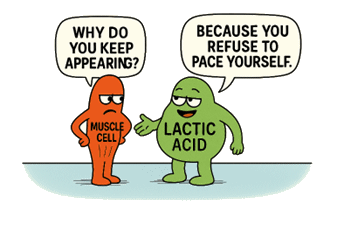
So I can respire without oxygen?Not sustainably. The problem is that only two ATP molecules are produced, instead of about 30 from aerobic respiration. That's enough for some types of bacteria, but not for anything much more complex, and certainly not enough for a human. Pain and muscle fatigue are your body's ways of telling the brain you need to slow down, take deep breaths and generate a lot more ATP by oxidising that lactic acid. The pain of angina arises in a similar way when the heart muscles are respiring anaerobically because they aren't receiving enough oxygenated blood - but that's a more serious problem. |
 |
Although "lactic acid" and "lactate" are often used interchangeably, this is incorrect. Lactate is the negative ion left behind when lactic acid loses a proton. It's a weak acid, so an equilibrium is set up, and any solution or body tissue which contains lactic acid will also contain lactate. Lactic acid is slightly less weak (dissociates more readily) than ethanoic or propanoic acids, because internal hydrogen bonding stabilises the lactate ion.

Yes. Nowadays, this is usually done through biotechnology using Lactobacilli. They can ferment sugars other than lactose, so they don't need to be fed on milk. Cane sugar or corn syrup will do.
An older route is via the reaction of hydrogen cyanide with ethanal. This reaction is often studied in A-level chemistry as an example of nucleophilic addition. Hydrolysis of the resulting 2-hydroxypropanenitrile yields lactic acid.

Not exactly. Lactic acid is a chiral molecule, with two non-superimposable mirror image forms.
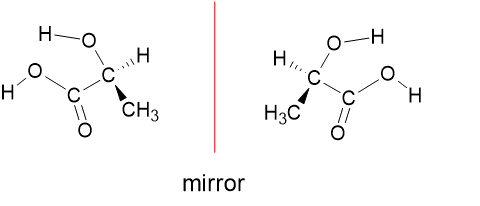
Reacting ethanal with hydrogen cyanide will give an equimolar mixture (racemic mixture) of the two. The lactic acid produced by anaerobic respiration in mammals is exclusively the L, or (+) form, the one shown on the left of the diagram. As for bacteria, some produce one mirror image, some produce the other, and some can make both. This suggests that the enzymes needed must have evolved more than once during the history of life.
PLA, for short. It's a polymer which can be made from sustainable resources, and which can be broken down by enzymes when we dispose of it. This makes it a promising replacement for polymers such as poly(ethene) which are not biodegradable, and whose raw material is crude oil or natural gas. PLA is a polyester. It forms when the carboxylic acid group of one lactic acid molecule reacts with the alcohol group of another, to form an ester link. Many lactic acid molecules link together in this way to form a polymer chain.

As with most esters, heating the starting material (just lactic acid, here) with a strong acid catalyst will produce PLA but only as a component of an equilibrium mixture. This was tried during a sixth-form research project at Eton, using concentrated sulfuric acid as the catalyst and distilling off the water to shift the equilibrium.
The result is shown in the left-hand flask in the picture below. The trouble is, sulfuric acid readily dehydrates carbohydrates to leave a black mess of carbon, and that's what appears to have resulted here. If your organic chemistry experiments ever end up looking like this, well, sometimes it just happens that way.
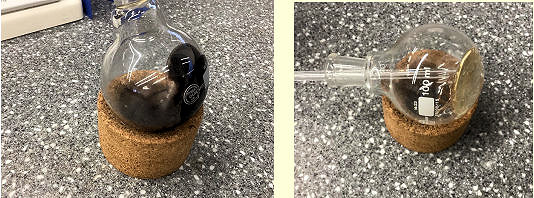
Results of experiments to polymerise lactic acid, using sulfuric acid catalyst (left hand flask) and phosphoric acid catalyst (right hand flask).
[Image: Roderick Edmonds]
We repeated the experiment using phosphoric instead of sulfuric acid, and obtained a much better sample of PLA (shown in the flask on the right in the picture).
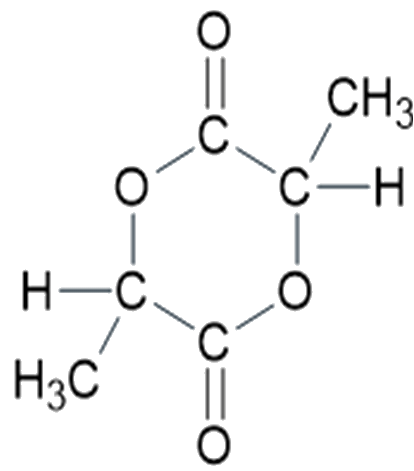
The industrial method first converts the lactic acid to a cyclic dimer. This is then polymerised using a catalyst of tin(II)octanoate. No water is released during the polymerisation, so there is no need to remove it to complete the reaction.
 |
|
| Dimer of lactic acid. [Image: Roderick Edmonds] |
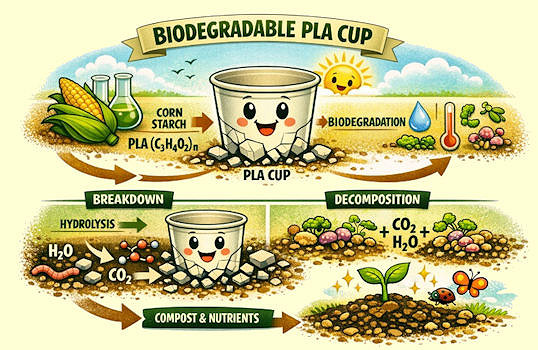
It's used in many types of packaging and containers. The picture shows a biodegradable cup made of PLA.
 |
 |
| PLA cup [Image: Roderick Edmonds] |
PLA cup processing [Image: Roderick Edmonds via Microsoft Copilot] |
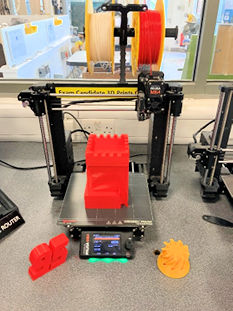
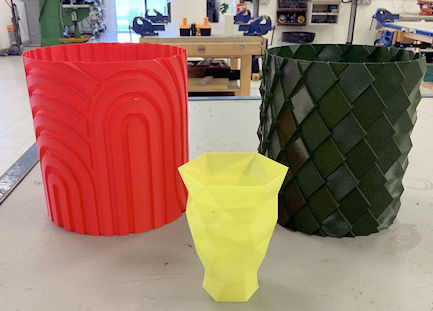
PLA is a good polymer to use in 3D printing, as it has a fairly low melting temperature as well as being biodegradable. The left-hand picture below shows a 3D printer set up with two spools of PLA, one of which has a red pigment added. The right hand picture shows a vase and some storage containers made with the printer.
 |
 |
| 3D printer loaded with PLA, and some printed articles. [Image: Roderick Edmonds] |
Containers made from PLA by 3D printing. [Image: Roderick Edmonds] |
Yes, other hydroxycarboxylic acids can also be polymerised. Hydroxyethanoic acid and 3-hydroxybutanoic acid are two examples. A co-polymer of lactic and hydroxyethanoic acids is used to make surgical thread which will slowly degrade inside the body so that there is no need for a follow-up procedure to remove it.
Not quite, but they are isomers. GHB or gamma-hydroxybutanoic acid is another name for 4-hydroxybutanoic acid. It's a recreational drug closely related to the neurotransmitter gamma-aminobutyric acid or GABA (see GABA, MOTM for July 2015).
 Back to Molecule of the Month page. [DOI:10.6084/m9.figshare.32397327]