
Methylene blue
(a.k.a. Methylthioninium chloride)
(a.a.k.a. 3,7-Bis(Dimethylamino)-phenothiazin-5-ium chloride)
The first synthetic substance to treat an infectious disease
Ediz Karakas
Eton College, UK
Molecule of the Month November 2026
Also available: HTML version.
|
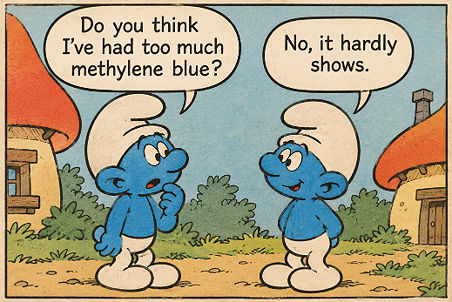
[Image: Ediz Karakas, created using ChatGPT. Text used with permission of Alex Kolesnikov.] |
 |
 |
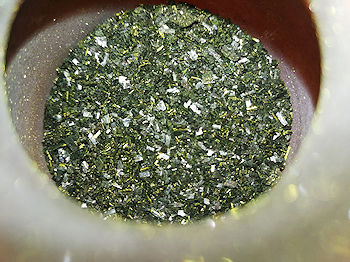
Dark-green methylene blue crystals
[Image: TimJW12, CC BY 3.0 via Wikimedia Commons] |
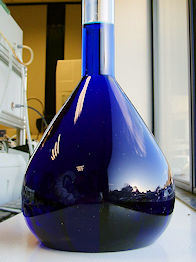
Methylene blue dissolved in water
[Image: Amanda Slater, Flickr user amandabhslater,
CC BY-SA 2.0 , via Wikimedia Commons, CC BY 3.0 via Wikimedia Commons]
|
That’s the bluest thing I’ve seen; surely this relates to its uses?
Yes, of course. Methylene blue is one of the oldest organic dyes, used first in 1876 to dye textiles. Methylene blue actually exists as dark-green crystals, but when dissolved in water, they form a blue solution. But it was in 1886 that Paul Ehrlich noticed that this blue solution could turn live neurones and the plasmodium parasite (which causes malaria) blue – more on that later. Since then, methylene blue has been used in microbiology, staining cell structures, like the nucleus and mitochondria, to make them easier to see under a microscope. While it is still selectively used to dye textiles, its applications in chemistry and medicine overshadow its original purpose.
How was it made?
German scientist Heinrich Caro was the first to synthesise methylene blue. With huge advances in chemistry occurring in the late 1800s, many chemists were scrambling to create synthetic dyes, and Caro was no exception. Having trained in Berlin as a textile colourist (also attending chemistry lectures), he synthesised methylene blue while working for BASF, a German company that is still the largest chemical manufacturer in the world. His synthesis involved the oxidation of p-dimethylaminoaniline (a common dye intermediate) and hydrogen sulfide with ferric chloride. The paper 'On the Mechanism of the Caro Synthesis of Methylene Blue' by F. Sánchez-Viesca and R. Gómez (see Bibliography) provides a fascinating and detailed account of the synthesis process, summarised below.)
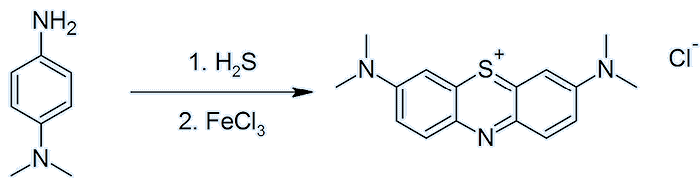
Caro's synthesis of methylene blue.
[Image: Rifleman 82, PD via Wikimedia Commons]
|
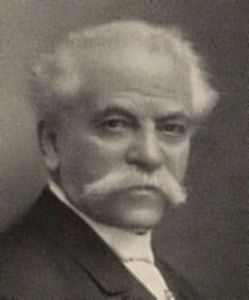
Heinrich Caro
[Image: BASF, PD via Wikimedia Commons] |
But why is it blue?
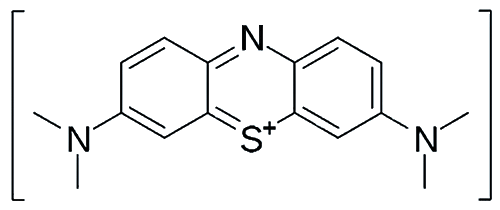
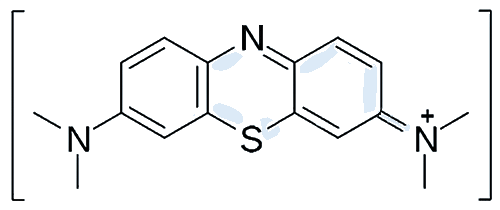
Methylene blue is a part of the phenothiazine family of molecules which comprise a hexane ring with a sulfur and nitrogen atom flanked by two benzene rings (plus a chloride counter ion), and it can be drawn in two ways (see diagram below). The structure of methylene blue contains many adjacent double bonds, making it a highly conjugated system, not unlike benzene (MOTM August 2011).
 |
 |
Methylene blue (structure 1)
[Image: YHarbinary, Public domain, via Wikimedia Commons] |
Methylene blue (structure 2)
[Image: YHarbinary, Public domain, via Wikimedia Commons] |
Such conjugated systems are often coloured due to their tendency to reflect specific wavelengths of visible light. Other well-known examples of this phenomenon include carotene, responsible for making carrots orange (MOTM for April 2002) and other carotenoid pigments, like lutein & zeaxanthin, (MOTM for June 2007); lycopene, the reason for the redness of tomatoes (MOTM for January 2020); and psittacofulvins, the pigments that give parrots their vibrant colours (MOTM for October 2025).
Can it be used for something other than as a dye?
Yes, its properties also make it a powerful redox indicator. In its standard oxidised state, it has its distinctive blue colour, but when reduced, it forms a colourless compound called leucomethylene blue.
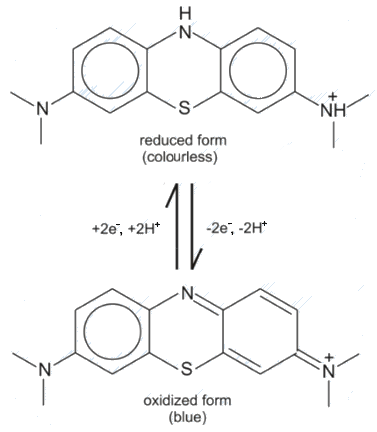
Methylene blue redox reaction.
Top: Leucomethylene blue (colourless). Bottom: Methylene blue (blue colour).
[Image: E. Prasetyo & F. R. Mufakhir, CC BY 3.0 via Semantic Scholar]
This colour change means that methylene blue can be used by scientists in biosensing, as it can provide a readable electronic signal. It has even been used in the milk industry; when milk has a high bacteria concentration, all the oxygen in it is used up and methylene blue is colourless; the converse is also true.
Methylene blue sounds like the real deal – so how is it utilised in medicine?
Well, several of the other drugs from the phenothiazine family have many clinical uses. Chlorpromazine is used to treat psychosis, bipolar disorder, szichophrenia and... severe hiccups! Another one, prochlorperazine is used for nausea and vomiting.
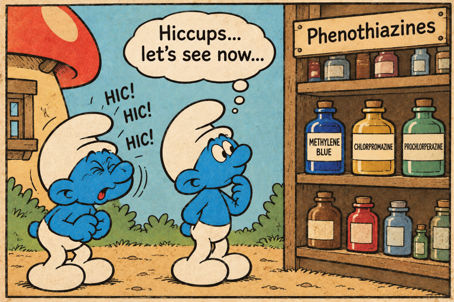
[Image: Ediz Karakas, created using ChatGPT.]
As for methylene blue itself - remember Paul Ehrlich? He used methylene blue to treat malaria, making it the first synthetic substance to cure an infectious disease. Although more slow-acting than quinine (see MOTM for July 2005) and less appealing in its administration (present in tonic water, quinine was often drunk as part of gin and tonic), methylene blue proved useful in targeting specific strains that had gained resistance and worked effectively alongside other treatments. Although it has now largely been phased out from this use, it is still occasionally administered as a 200 mg daily oral dose.
So, it’s completely unused in hospitals now?
Several antiquated applications of methylene blue have been phased out, but it is still used for a number of conditions. Most prominently, as a treatment for methemoglobinemia and as an emergency antidote.
|
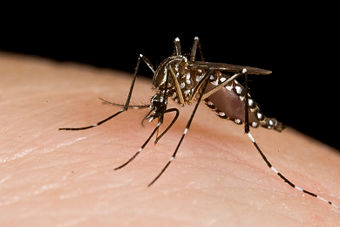
Mosquito bites transmit malaria
[Image: Department of Foreign Affairs and Trade, CC BY 3.0 via Wikimedia Commons] |
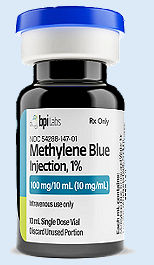
Bottle of methylene blue.
[Image: Melbourne Pharma, CC BY 3.0 via Melbourne Pharma] |
Methemo- what?
Methemoglobinemia is a condition where the ferrous iron (Fe2+) prosthetic group in haemoglobin (MOTM for February 2006) is replaced by a ferric iron (Fe3+) ion, most commonly due to an adverse reaction to various medicines, such as numbing agents and antibiotics. This can prevent oxygen from being delivered correctly to the body’s tissues. When administered intravenously, methylene blue is reduced by NADPH into leucomethylene blue (see above), which is itself a powerful reducing agent. This allows the abnormal Fe3+ to gain an electron and become ferrous iron Fe2+, restoring haemoglobin’s function. Interestingly, in high concentrations, methylene blue can act as an oxidising agent, causing methemoglobinemia by oxidising Fe2+ into Fe3+.
|
Where do the Smurfs come in?
It's a joke, inspired by the image below.
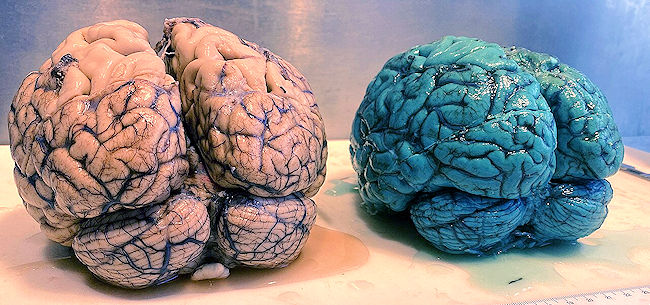
A brain stained by methylene blue
[Image: Mikael Häggström, CC BY 3.0 via Wikimedia Commons]
This image is real and, no, it isn’t the brain of a Smurf! Patients treated with high doses of intravenous methylene blue have been found to have bright blue organs after death, although this is purely a post-mortem phenomenon. Known as ‘avatar’ or ‘pistachio’ discolouration, it is a product of the colourless leucomethylene blue being oxidised back into methylene blue upon exposure to air. In fact, methylene blue has been found to act as an electron carrier in cells that can increase energy production and reduce oxidative stress, which, in turn, has led to hopes that it can improve attention span and short-term memory, though results so far are inconclusive.
I've heard methylene blue called 'Bad Medicine'?
Nothing to do with Bon Jovi, I’m afraid. Searching 'methylene blue' on the internet, you might notice that, aside from the treatment of methemoglobinemia, there are a number of other ‘off-label’ uses propagated by health and wellness trends. From improving cognitive function (mentioned earlier) to enhancing longevity and combatting fatigue, a multitude of unsupported claims have been made about methylene blue, and you can find dozens of videos on Youtube claiming that methylene blue is a new wonder drug that improves your life greatly simply by drinking it, or injecting(!) it, regularly. None of these claims have any proper scientific evidence to back them up. And they come with risks.
|

Bon Jovi singing 'Bad Medicine'.
[Image: Rosana Prada, CC BY 3.0 via Wikimedia Commons]
|
If methylene blue is used in combination with tricyclic antidepressants or serotonergic drugs, it can lead to 'serotonin syndrome', where a fatal level of serotonin (MOTM for April 2005) builds up in the body. Large doses are also fatal and can lead to haemolysis (the premature death of red blood cells), causing respiratory and cardiovascular distress. Non-pharmaceutical-grade methylene blue is also often contaminated with heavy metals, increasing potential toxicity.
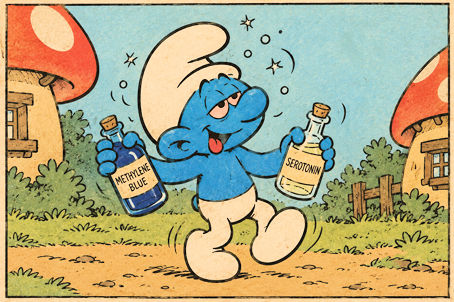
Don't mix methylene blue with other medicines...
[Image: Ediz Karakas, created using ChatGPT.]
A bonus? Aren’t you lucky.
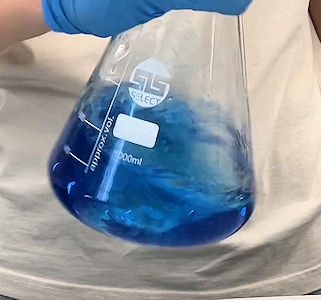
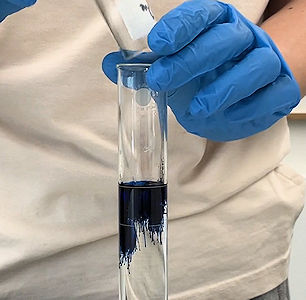
Methylene blue’s properties as a redox indicator make for some pretty cool practicals. Below are two videos of the author conducting the famous ‘blue bottle’ experiment. Here, you dissolve methylene blue in ethanol before mixing it with water, which has had potassium hydroxide and glucose dissolved in it. The alkaline solution of glucose reduces the methylene blue, making it colourless (see above for details). Vigorous shaking then adds oxygen into the solution, oxidising the methylene blue and changing it back into its vibrant blue colour. When the dissolved oxygen is consumed, the glucose reduced the methylene blue once more, turning it colourless.
 |
 |
| Video 1 - oxidation of the colourless form of methylene blue to make the blue version. |
Video 2 - Dissolving methylene blue crystals in ethanol. |
Bibliography
- Wikipedia: Methylene blue.
- Pioneering thinker - then and now: Methylene blue, BASF.com, 2015, February 5.
- Bužga, M., Machytka, E., Dvořáčková, E., Švagera, Z., Stejskal, D., Máca, J., & Král, J., Methylene blue: a controversial diagnostic acid and medication?, Toxicol. Res. (Camb.). 11, (2022) 711-717.
- Sánchez-Viesca, F., Gómez, R. On the Mechanism of the Caro Synthesis of Methylene Blue. Earthline J. of Chem. Sci. 209-214 (2021). d.o.i.: 10.34198/ejcs.6221.209214.
- Methylene Blue Injection. Cleveland Clinic.
- Cuffari, B. Potential Health Benefits of Methylene Blue, News Medical (March 5th 2025).
- Ginimuge, P. R., & Jyothi, S. Methylene Blue: Revisited, J. Anaesthesiology Clin. Pharmacol., 26 (2010) 517-520.
- Goldman, L., What to know about methylene blue, Harvard Health Publishing, 2025, April 24.
- Howland, R.H., Methylene Blue: The Long and Winding Road from Stain to Brain: Part 1, J. Psychosocial Nursing and Mental Health Serv. 54, (2016) 21-6.
- Nickson, C. Methylene Blue. Life in the Fastlane (2024).
- Ostrovsky, A., & Afzal, M. Methylene Blue, StatPearls (2026).
- Can Blue Dye make me Smarter?, BBC iPlayer, Clickbait Clinic with Stacey Dooley, Series 1, ep.5. (Oct 12, 2026).

 Back to Molecule of the Month page. [DOI:10.6084/m9.figshare.34004058]